
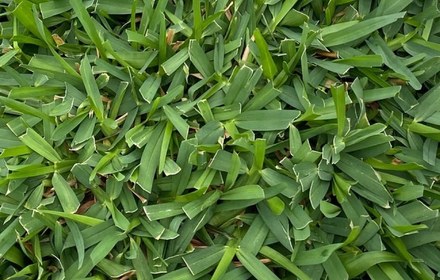
If you’ve driven through any Houston-area neighborhood built in the last twenty years, you’ve walked on Raleigh St. Augustine. It’s the most widely installed grass in the Greater Houston market for a simple reason: it’s tough, it’s affordable, and it does well in the heavy clay and gumbo soils that make up most of our yards.
Raleigh isn’t the fanciest grass we sell — Palmetto has a finer blade and better shade tolerance, and the Zoysias have a more manicured look. But for full-sun yards, large resods, and homeowners who want a reliable, budget-conscious lawn that establishes fast, Raleigh is usually the right call.
Who Raleigh Is Best For
- Full-sun front and back yards with 6–7 hours of direct light
- Large resods and new construction lots where cost per pallet matters
- Homeowners who want fast establishment and don’t want to fuss over a reel mower or a strict watering schedule
- Anyone dealing with Houston’s heavy clay soil — Raleigh tolerates it better than most
It is not a shade grass. If more than a third of your yard sits under mature oaks or pines, look at Palmetto or Amerishade St. Augustine instead — Raleigh will thin out fast in low light.
Growing Conditions
| Factor | Raleigh St. Augustine |
|---|---|
| Sunlight | 6–7 hours minimum |
| Drought tolerance | Medium |
| Foot traffic | Medium |
| Growth rate | Fast |
| Maintenance level | Medium |
| Coverage | ~450 sq ft per pallet |
Raleigh spreads by above-ground stolons, which is why it establishes and fills in bare spots quickly — but it also means it has no underground rhizomes to fall back on if it’s damaged. More on that below.
Recommended Mowing Height & Frequency
Set your mower to 3–4 inches, and mow every 7–10 days during the growing season (roughly March through October in Houston).
This is taller than a lot of homeowners expect. St. Augustine performs worse the shorter you cut it — deeper blades mean deeper roots, better drought resistance, and better shade tolerance in the parts of your yard that get afternoon shadow from your house or fence line.
Never scalp Raleigh. Because it has no rhizomes underground, cutting it too short (or all at once after letting it get shaggy) can kill the crown of the plant outright, leaving bare dirt instead of grass. Stick to the one-third rule: never remove more than a third of the blade length in a single mow.
Watering Needs
Raleigh needs the most water of the three grass types we carry — plan on 1 to 1.5 inches per week, split across 2–3 sessions, more in peak summer heat above 95°F.
- New sod: Water twice a day (morning and evening, never midday) for 2–3 weeks, then transition to the established schedule once it’s rooted (tug-test a corner — resistance means it’s taking root).
- Established lawns: Water early morning, between 5 and 10am. Evening watering in Houston’s humidity is the single biggest cause of brown patch and gray leaf spot in St. Augustine lawns — don’t do it.
- The finger test: if the soil feels muddy 2–3 inches down, skip a day. If it’s dry and hard, water.
Fertilizing & MicroLife Recommendations
Raleigh needs 2–3 lbs of nitrogen per 1,000 sq ft per year, applied every 6–8 weeks through August.
- MicroLife Multi-Purpose 6-2-4 is the standard choice — a 100% slow-release organic fertilizer that works on all grass types and won’t burn new roots. Apply 15–20 lbs per 1,000 sq ft, and repeat every 3–4 months.
- If your Raleigh is looking pale or yellow rather than deep green, that’s usually an iron/pH issue in Houston’s alkaline clay — switch to MicroLife Acidifier 6-2-4, which adds 12% sulfur to lower soil pH and correct yellowing, often within a couple of weeks.
- In September, apply MicroLife Brown Patch 5-1-3 preventively — Raleigh’s biggest disease risk shows up as cooler, wetter fall weather sets in.
- Never fertilize new sod for the first 30 days, and stop all nitrogen applications by the end of August so the grass doesn’t push tender new growth right before the first cold snap.
Common Problems
- Chinch bugs are Raleigh’s #1 pest in Houston — look for yellow, expanding patches in the hottest, sunniest parts of the yard (especially near concrete) from June through September.
- Gray leaf spot shows up as irregular gray lesions on the blades, usually in shaded, humid areas — caused almost entirely by evening watering.
- Brown patch appears as circular brown/tan patches, most common September through November as nights cool down.
Pros & Cons
Pros: Fast establishing, most affordable St. Augustine option, tolerates Houston’s clay soil well, widely available, forgiving of imperfect care.
Cons: Needs full sun, thirstiest of our grass options, susceptible to chinch bugs and brown patch, cannot be scalped or it may not recover.
Ready to Order Raleigh St. Augustine?
Raleigh is in stock and ready for same-day delivery across Magnolia, Tomball, and the rest of the Greater Houston area. Call us at (281) 259-6375 and tell us your square footage, or get a free quote online — we can usually tell you exactly what you need in about two minutes.