
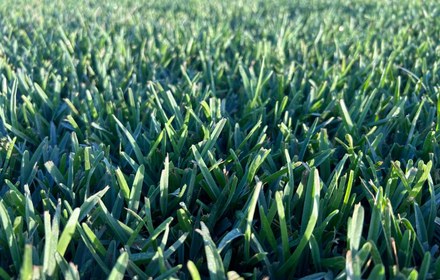
Palmetto is the St. Augustine variety we recommend most often for premium residential lawns in Houston’s older, tree-heavy neighborhoods — Heights, West U, Memorial, and River Oaks are full of it. It has a finer blade and darker, more even color than standard Raleigh, and it holds up noticeably better in the mixed sun/shade conditions those neighborhoods create.
If your yard gets a healthy mix of direct sun and afternoon shade from mature trees or a two-story house, Palmetto is usually the better long-term investment over Raleigh — you’ll get thicker, more consistent coverage where Raleigh would thin out.
Who Palmetto Is Best For
- Yards with a mix of sun and shade — Palmetto tolerates as little as 4–5 hours of light
- Homeowners who want a finer-textured, more manicured look than Raleigh provides
- Properties in established, tree-lined neighborhoods
- Anyone who wants better drought tolerance than Raleigh without switching grass types entirely
Growing Conditions
| Factor | Palmetto St. Augustine |
|---|---|
| Sunlight | 4–5 hours minimum |
| Drought tolerance | Medium–High |
| Foot traffic | Low–Medium |
| Growth rate | Moderate |
| Maintenance level | Medium |
| Coverage | ~450 sq ft per pallet |
Palmetto trades a bit of foot-traffic tolerance for shade performance — it’s a better fit for a lawn people look at than one that hosts daily backyard football.
Recommended Mowing Height & Frequency
Mow at 3–4 inches, every 7–10 days during the growing season. In the shadier parts of your yard, stay at the top of that range (closer to 4 inches) — taller blades capture more of the limited light and keep the grass denser under tree canopy.
As with all St. Augustine varieties, do not scalp Palmetto. It spreads by stolons with no underground rhizomes, so cutting the crown too short can kill the plant outright rather than just setting it back.
Watering Needs
Palmetto is thirsty, though slightly less so than Raleigh thanks to its better drought tolerance rating.
- New sod: Water twice daily — once in the morning, once in the evening, never during midday heat — for 2–3 weeks until rooted, then transition to the established schedule.
- Established lawns: 1–1.5 inches per week, always in the early morning (5–10am). Palmetto’s shade tolerance means it’s often planted in exactly the conditions — shade plus moisture — where gray leaf spot thrives, so morning-only watering matters even more here than with Raleigh.
- Reduce watering in cooler months to limit brown patch risk, which increases with overwatering as temperatures drop in fall.
Fertilizing & MicroLife Recommendations
Palmetto needs 2–3 lbs of nitrogen per 1,000 sq ft per year, applied every 6–8 weeks through August — the same annual need as Raleigh.
- MicroLife Multi-Purpose 6-2-4 is the right all-around choice for regular feedings — 15–20 lbs per 1,000 sq ft every 3–4 months.
- Because Palmetto is often planted in partial shade where it works harder for light, keeping it well-fed matters more than with full-sun grasses. If color looks washed out rather than a deep, even green, add MicroLife Acidifier 6-2-4 — Houston’s alkaline soil ties up iron, and Acidifier’s sulfur content corrects that and greens the lawn back up.
- Apply MicroLife Brown Patch 5-1-3 preventively in September, especially in the shaded zones where humidity lingers longest after rain or irrigation.
- Skip fertilizing new sod for 30 days, and stop nitrogen applications by the end of August.
Common Problems
- Gray leaf spot is Palmetto’s most common issue — irregular gray lesions on the blades in shaded, humid spots. Almost always tied to evening watering; switch to mornings only.
- Brown patch shows up as circular tan patches, mainly in fall as nights cool.
- Chinch bugs are less common in shaded Palmetto lawns than in full-sun Raleigh, but can still appear in the sunnier sections of a mixed-light yard.
Pros & Cons
Pros: Best shade tolerance of the widely-planted St. Augustine varieties, finer blade and darker color than Raleigh, better drought tolerance than Raleigh.
Cons: Slower growth means slower recovery from damage, lower foot-traffic tolerance, still susceptible to gray leaf spot and brown patch in shade.
Ready to Order Palmetto St. Augustine?
We stock Palmetto for delivery across Magnolia, Tomball, and Greater Houston. Call (281) 259-6375 or get a free quote online and we’ll help you figure out exactly how much you need for your yard’s mix of sun and shade.