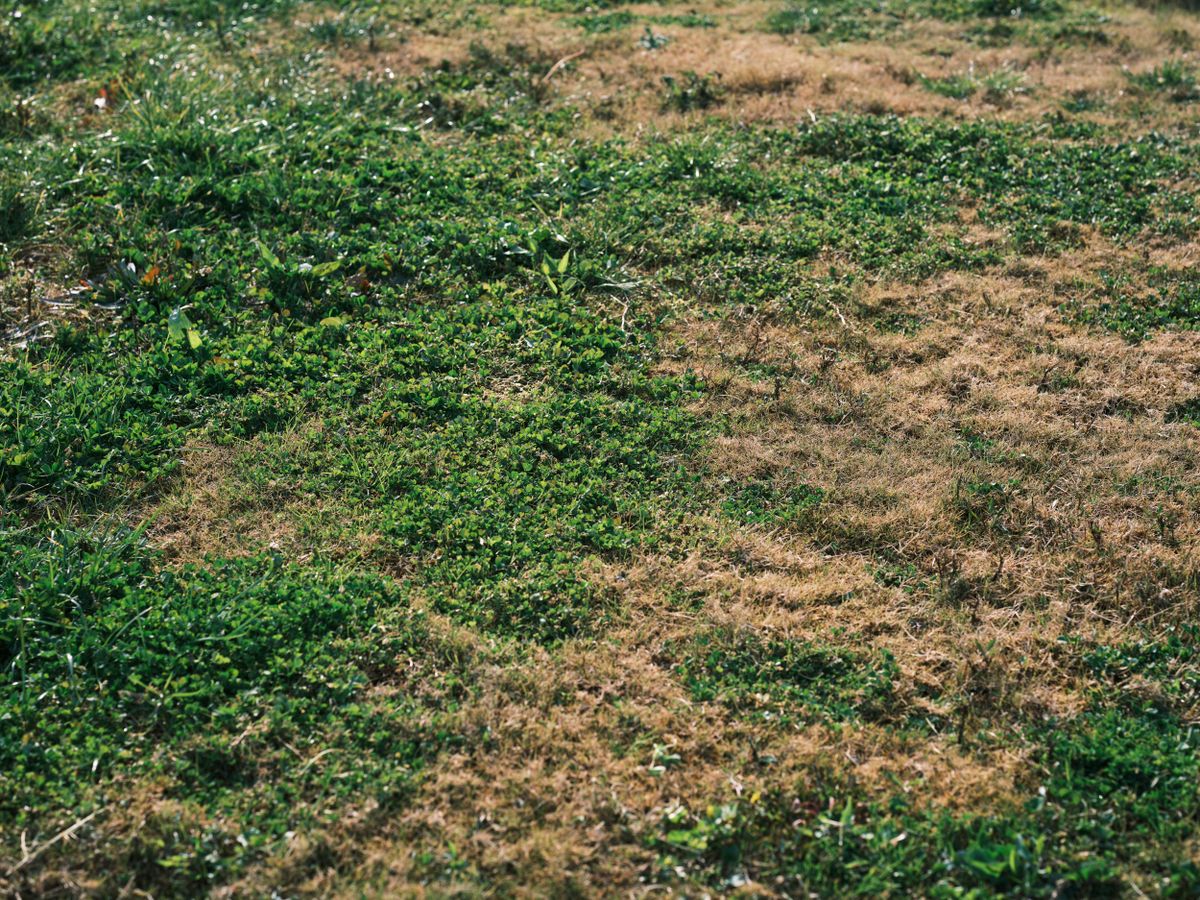
If you’re seeing roughly circular brown or yellow-brown patches spreading across your lawn, you’re almost certainly dealing with one of two closely related fungal diseases — both caused by the same fungus family (Rhizoctonia), but showing up differently depending on your grass type.
Brown Patch (St. Augustine)
Brown patch is the most common fungal disease in Houston St. Augustine lawns, especially during the cooler, humid stretches of spring and fall when nights are cool but days are still warm.
What it looks like: Roughly circular patches, usually 6 inches to several feet across, that turn brown or yellow. Look closely at the edge of an active patch — blades often pull away from the runner (stolon) with a slight tug, and the base of the blade near the soil will look rotted or discolored while the runner itself stays alive. That’s the telltale sign vs. other causes of brown grass.
What triggers it: Overwatering, especially evening watering that leaves grass wet overnight. Cool, humid weather. Excess nitrogen right before a cool snap.
Large Patch (Zoysia)
Large patch is essentially the Zoysia version of the same disease, and it’s the #1 disease problem we see in Zoysia lawns in the Houston area — especially Palisades and Emerald.
What it looks like: Similar circular patches, but often larger (hence the name) and slower to recover than brown patch. Active in the same cool, humid conditions — typically shows up in fall as temperatures drop and again in spring as the lawn tries to green up.
What triggers it: Same as brown patch — excess moisture, poor drainage, and temperature swings. Zoysia’s naturally slower spring green-up (see our dormancy vs. dead guide) can make large patch damage harder to spot at first, since slow-to-green Zoysia looks similar to disease-damaged Zoysia.
How to Tell Them Apart From Other Brown Spots
| Symptom | Likely Cause |
|---|---|
| Circular patches, blade pulls from stolon easily at wet edge | Brown patch / large patch |
| Yellow patches expanding fast near hot concrete in summer | Chinch bugs — see chinch bug guide |
| Grass stripped bare within 2-3 days, Aug–Oct | Armyworms — see armyworm guide |
| Irregular gray lesions on individual blades | Gray leaf spot — see gray leaf spot guide |
| Won’t green up at all by late spring, roots pull up dead | Winter kill, not disease |
Treatment
- Reduce evening watering immediately. This is the single biggest lever you control. Water early morning only (5–10am) so grass has all day to dry out.
- Apply MicroLife Brown Patch 5-1-3 at 15–20 lbs per 1,000 sq ft. It works through microbial disease-fighting bacteria and fungi that biologically compete with the disease-causing organisms, rather than a harsh chemical burn. Apply at first sign of active disease.
- Don’t panic-fertilize. Extra nitrogen while disease is active can make it worse — hold off on high-nitrogen feeding (like MicroLife Hybrid) until the patches have recovered.
- Be patient. Even with correct treatment, recovery takes weeks, not days — the fungus stops spreading quickly, but the damaged grass needs time to fill back in.
Prevention
The best treatment is prevention, applied before the disease shows up:
- September is the key preventive window for both St. Augustine and Zoysia in Houston — apply MicroLife Brown Patch before the fall cool-down triggers an outbreak.
- Keep watering to mornings only, year-round.
- Avoid heavy nitrogen applications in early fall — switch to a lighter, potassium-leaning feed instead as temperatures start dropping.
- Improve drainage in low spots that hold water — persistent wet areas are where this disease shows up first and worst.
Get It Treated
Pick up MicroLife Brown Patch 5-1-3 at our Magnolia or Tomball yard, or call us at (281) 259-6375 and describe what you’re seeing — we can usually tell you over the phone whether it’s disease, pests, or something else before you spend money on the wrong treatment. If patches have killed grass down to bare soil, get a free quote for a resod of the affected area.